
Perhaps it’s been a month or three since you took a painting class at ReaperCon, or NOVA, or Gen Con, or a local event. Or maybe you recently watched a great how-to miniature painting video. Whatever it is you’ve recently been studying, I encourage you to sit down and actually practice what you learned as soon as you can. I’ve been practicing something I learned in a class on this troll, and I wish I’d gotten to the practice a lot sooner.
 The finished rock troll from Reaper Miniatures.
The Project
In February 2025, I took a bust painting worskhop with James Rice in conjunction with attending the Atlanta Miniature Figure Show. It was a great workshop. Jim Rice is a fantastic teacher and I highly recommend taking a class with him if you get the opportunity. I really liked Jim’s approach to teaching the concept of volumes and how to paint them, but I struggled during the workshop with implementing some of the approach. The concepts made sense, and I understand them on the paper and flat we practiced with. What I struggled with was translating the information to full 3D, and, as ever, being far too timid with contrast.
 Left: James Rice’s bust; Right: my attempt
I knew what some of the issues were: I was unfamiliar with the paint we were using, and I’m a slow painter who just takes more time than is usually available in a workshop. I also knew that there was one reliable way to cement what I understood and expand on it: practice. I left with the intention to practice the process as soon as possible, both on a second copy of the bust, and on a rock troll.
We all know how good intentions go, so it’s needless to say that’s not what I did! The same health and life stuff that has kept me from doing much with this blog kept me from painting much. It had been my intention to paint the troll on my Twitch stream on the Reaper Miniatures channel, and some months later I finally got around to that! I painted it over a series of three and a half stream episodes. Since I was painting on live video, I was not able to take WIP photos at every stage I might have liked, but I took photos at the end of each streaming session.
Painting Session 1
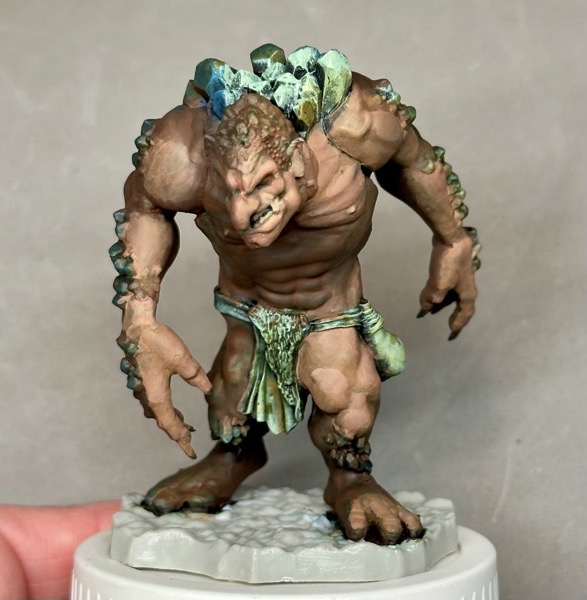 From the end of the first session. While studying the figure in between sessions, I realized that some light would reach areas of the ribcage and abdomen.
My first task was to remind myself of the process from the workshop! I read through the handount James Rice provided, as well as the notes and photos I took during the workshop. This is the reason I recommend practicing as soon after a learning opportunity as you can – more of the information and the experience will be fresh in your mind. Even those with better memories than mine (almost everyone) will find things much less fresh after 6+ months.
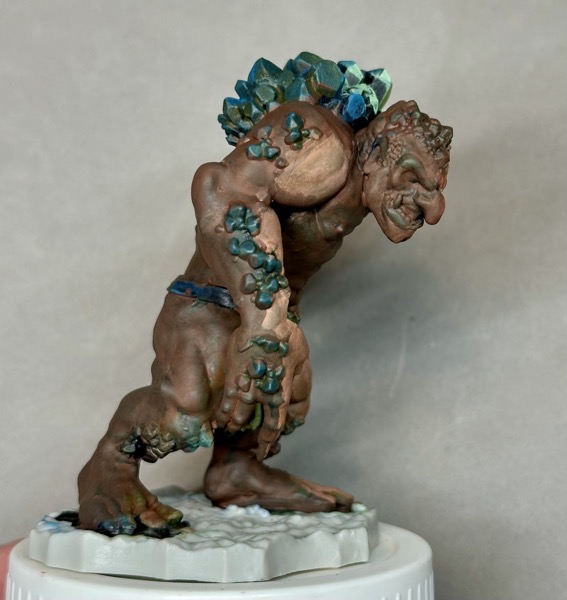 End of the first session.
I started with a black base coat. Part of my goal was to paint more extreme light and shadow than I would usually do. Sort of OSL (object source lighting), but with the source of the light just out of frame of the miniature. I began by drybrushing in some basic highlights, using yellowy greens in the area of the light, and bluish greens in the shadow area. I planned to paint the figure with reddish/orangish earthy brown colours, so chose complementary colours for the underpainting, in the tradition of verdaccio, and following what we did in the workshop to paint reddish/orangish human flesh tones.
Next I applied a glaze all over the figure, although I did not paint this over all of the crystals on the back. I don’t have a lot of inks like the instructor used, so I used Reaper’s Sepia Wash instead. You can see the effect of the wash over the verdaccio underpainting on the clothing and arm crystals in the first session photos. I did no further work on the shadow areas in the first session.
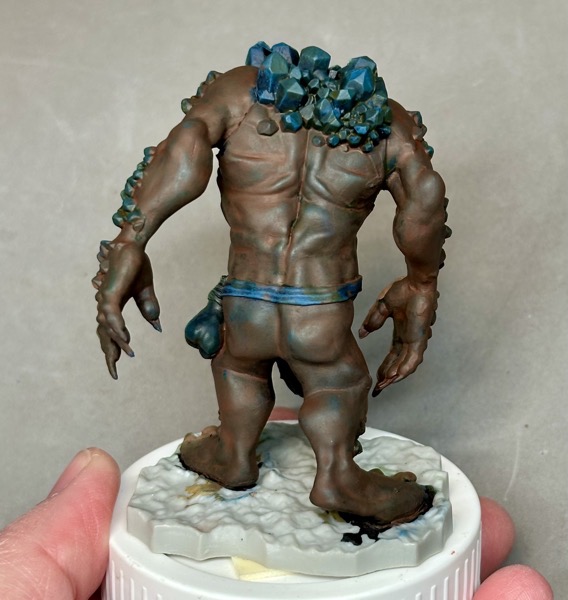 End of the first session.
The next step was to begin adding layers of lighter paint to the lit areas. I painted two layers during the first session. I’ve been using the 2.0 Master Series Paints as much as I am able to on stream so people can see them in action. I have access to a handful of great brown colours, but they were a little neutral for what I wanted for this project. I mixed a bit of somewhat rusty red into my brown to warm it up.
Painting Session 2
 From the end of the second session.
There’s a bit of a colour shift in the light area between the first and second painting sessions. For the second session I mixed a rich orange with my earthy browns to warm them up, rather than the rusty red I had used in the first session. Partly this was because I live somewhere with orangey earth and I wanted to mimic that a little. I also thought that the reddish colour would turn more pastel and desaturated than the orange would with the addition of lighter colours to mix the lightest level highlights.
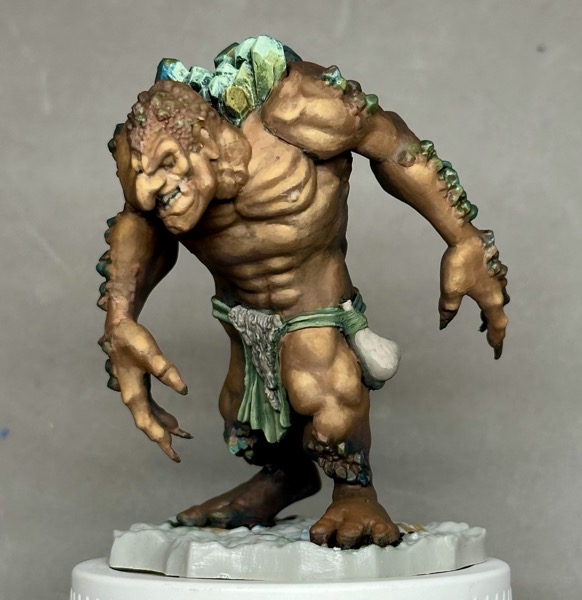 From the end of the second session.
I also painted in some lighter areas on the shadow side, being sure to keep these much darker in value than what I was painting on the lit side. I kept the rich greenish-black colours in the recesses and added a dark brown to the upward facing masses of muscles
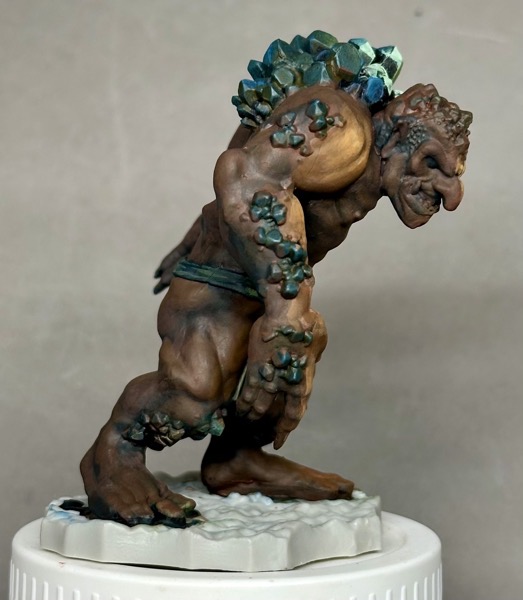 End of second session.
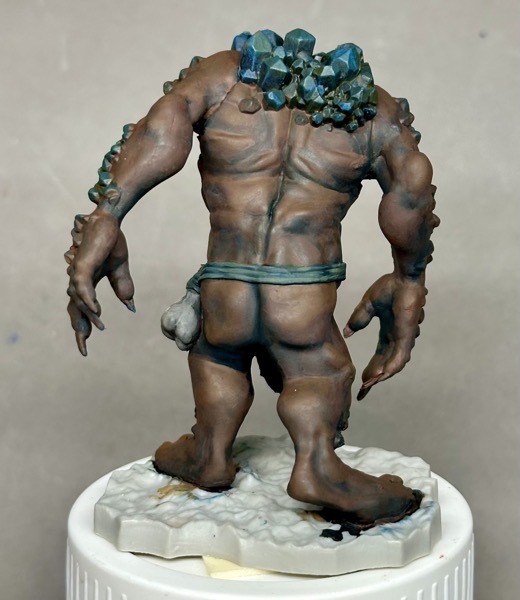 End of second session.
Towards the end of the stream I worked on the accessories. I painted the wolf pelt and the tooth weapon with neutral colours. I left the belt and loincloth the greenish colours of the underpainting and just added some shade and highlight. (Though as you’ll soon see, I became dissatisfied with that decision.)
 End of second session.
Painting Session 3
Finally I reached a point where I could no longer put off dealing with the crystals! To paint these very well would be a time-consuming affair, so I went for a compromise. I mixed up pools of paint of different values and hues and quickly painted these over the various facets to try to suggest the way the facets catch light differently. I like the contrast of the blue and turquoise with the skin colour, really gives him a fantasy touch.
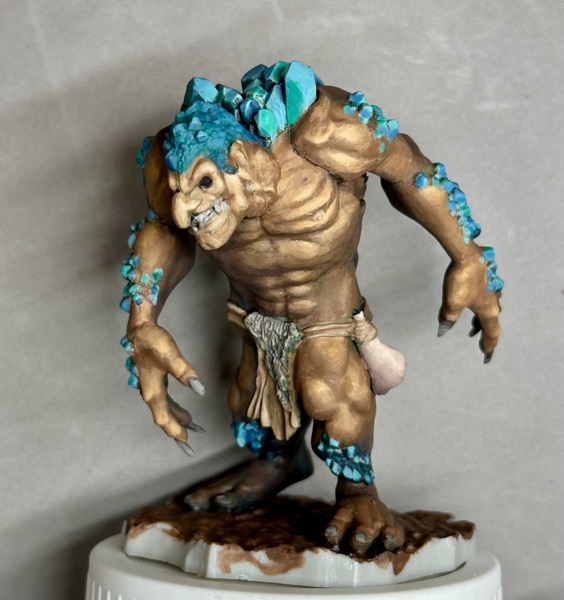 From the end of the third session.
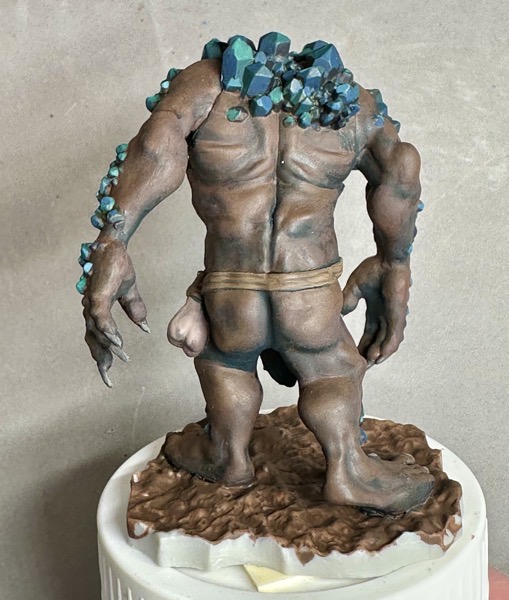 End of third session.
I wanted to add a little more highlighting to the face, and did this using a cool colour mixed into the lighter skin colour. I initially tried the cool colour on its own, but the difference was too stark.
 End of third session.
I felt I had given the accessories short shrift in the previous session and wanted to take a second look at those. The tooth just needed a bit more paint and blending. I shifted the leather colour to more of a tan. It doesn’t stand out as much from the figure as the previous greenish colour, but that is okay since it’s not a key story element of the figure as I’ve painted it. I think it looks much more natural and appropriate.
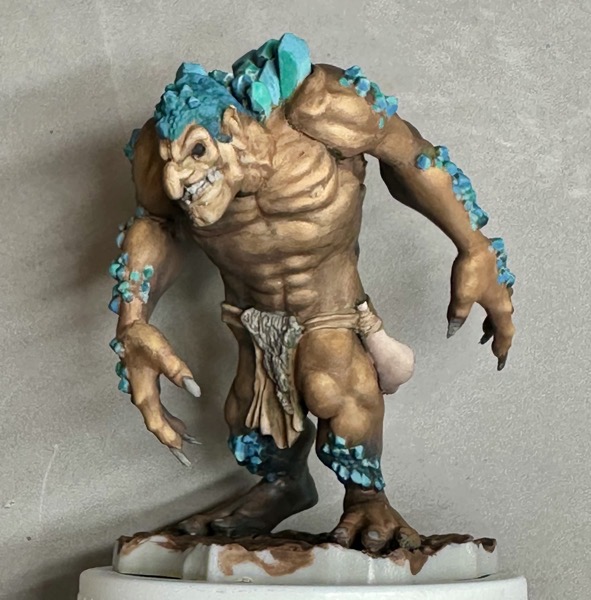 End of third session.
I also painted the teeth, fingernails, and toenails. I gave the base a quick coat of brown dirt to be able to better assess the overall figure than against the flat grey.
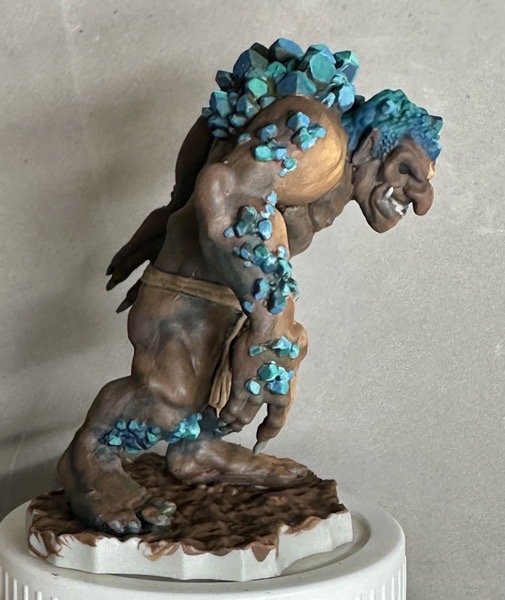 End of third session.
Painting Session 4
The figure was so close to finished, but it wouldn’t require a full stream’s worth of work, so I worked on a combination of figures for my next stream. On the troll, I used mixes of a couple of different purples to shade some of the crystal facets. I also worked the warmer purple colour into the skin shadows on the lit side. I applied some green in a similar way to the crevices of the loincloth and belt. I added a reflection dot to the eyes, and some highlights to the teeth on the lit side.
 From the end of the fourth session.
Although these additions were minor in effort and time, I feel they add a significant amount to the final outcome so I’m pretty happy I took the time. The seminar I took had covered painting details and adding colour touches like a flush on the cheeks and nose, so it made sense to do something similar on my practice troll.
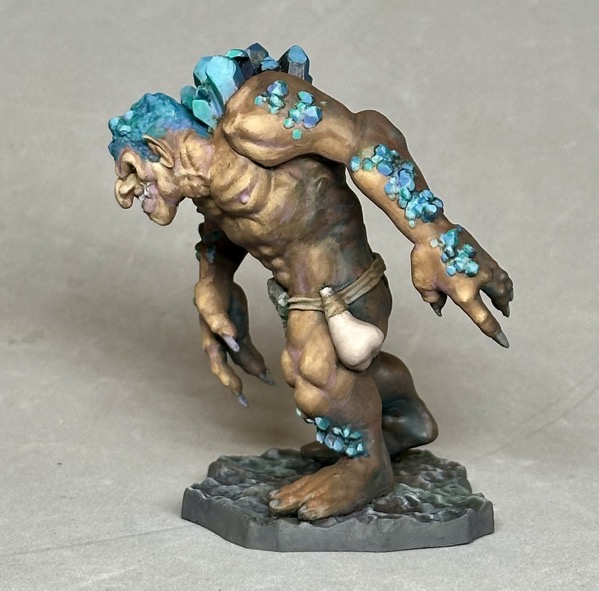 End of fourth session.
Lastly I worked on the base. I decided I wanted more of a stony rather than earthy look. I started with some wet on wet painting with various greys, browns, and greens. Then a wash of a dark colour, and sidebrushing up with lighter greys. I glazed in more of the browns and greens where the effect was too dampened.
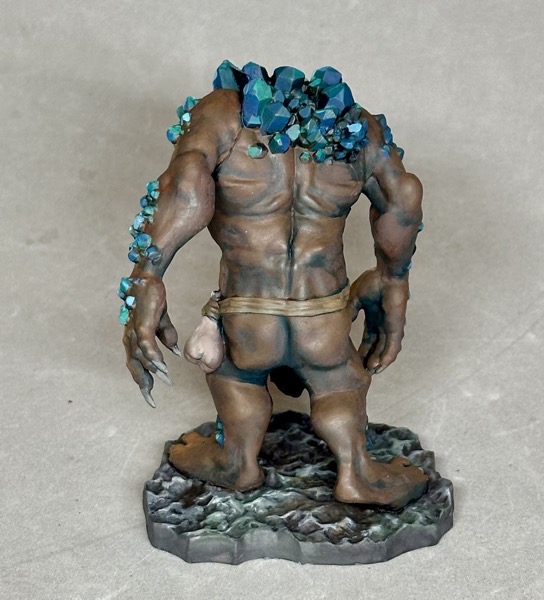 End of fourth session.
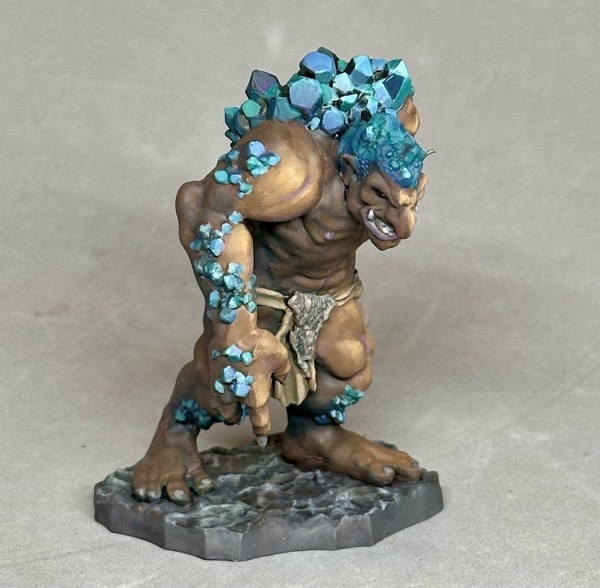 End of fourth session.
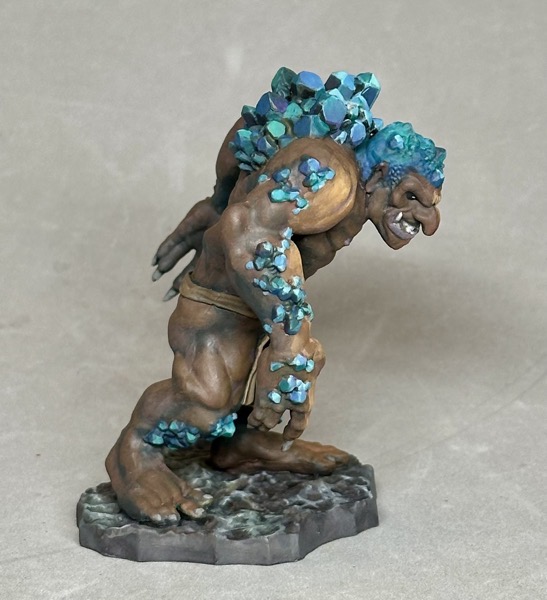 End of fourth session.
Assessing my Practice Sessions
My practice session with this troll gave me a better understanding of the technique that Jim Rice introduced in his class. I also attempted some colour underpainting on another bust I painted earlier this year. While I have a better understanding, I’m not sure my execution of colour based underpainting attempts have been very successful. Maybe it just doesn’t fit in with how I paint and my understanding of the materials. One of the properties of acrylic paint is that it is opaque, and the way to cover over mistakes and tweak basics is literally to cover them over with paint. Colour based underpainting requires manipulating the paint to be somewhat transparent to reveal the colour underneath. For me this feels much less intuitive, and less forgiving of mistakes.
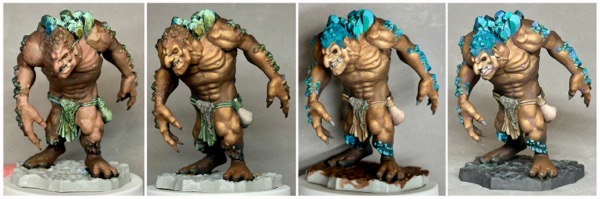 From first to last painting session.
For me, it feels more natural to focus the foundational stages of painting on value (light and dark). A value based underpainting, like zenithal priming, creates a roadmap to follow for where things should appear lighter or darker. You can use it as a quick painting technique as with slap-chop, but you can also paint over it completely and repeatedly and still get value from having done it. When I was working on the other bust I spent a lot of time tweaking the shadows, and I don’t think think it’s possible that any of the original colour variations can still be showing through all that paint.
I love colour variation, but I typically add it in the final stages of painting. Acrylic paint is easily thinned down to near transparency, allowing it to be easily applied over previous work. This can be done with regular brush or airbrush, or even with materials other than acrylic paint, like weathering pigments. Value is the foundation of a successful painting, so to me it makes sense to fiddle and make mistakes in the foundational stages with basic colours, and then get fancier with colour in the middle and late stages of painting.

 Bird with a Brush