If you like the work I do on this blog, please consider supporting it via my Patreon or a Ko-fi tip.
Are you looking to compete? Take a look at this calendar of conventions and shows that include miniature contests.
 Prizes and awards at the MSP Open in 2019.
This article outlines general information about various contest formats and other terms related to miniature painting and sculpting contests that are held at conventions and shows. I also have an article with some more general information about why it’s worth attending a convention or showing up to a show.
If you were hoping to learn about common issues contest judges see in miniature entries, check out the Common Feedback Issues Index and get some tips for how you could improve your entries.
Podium or Top Three Contest
Podium format contests are organized like the Olympics – there are a set number of winners. First, second, and third is pretty common, but some contests award first through fifth place, and a small contest may only award first place. The Golden Demon contests are an example of a classic podium style contest.
Some podium contests also recognize non-winning pieces that were in contention for one of the final prizes. These might be indicated by display on a first cut shelf, or with a commendation sticker applied to their entry sheet. A contest with multiple categories may also award an overall best of show winner from among the winners in each category.
The entries in a podium contest are usually displayed on shelves in glass cases, organized by category. Typically they are displayed anonymously, with no additional information provided about the piece or the artist. Submitted entries are handled only by contest staff, who determine their location on the shelves and move them around as necessary for judging or photography. Glass cases are protective, but are not ideal for viewers. It can be difficult to view entries placed on the highest and lowest shelves, and the viewing area is often crowded and loud.
 Left: Sophie trophies for the top three Reaper figures in each category at the MSP Open 2019.
Right: Large Monster trophies.
The prizes in a podium contest can vary widely. Options include trophies and ribbons, money, and prize packages of figures, game books, or hobby tools. The more valuable and prestigious the prizes, the more likely it is that the contest will attract larger numbers of highly skilled artists. However, that doesn’t mean that up-and-coming painters have no reason to enter a big contest! Manufacturers and individuals may offer bonus prizes and awards in addition to those awarded by the contest itself. There is more information about that in another entry below.
A podium contest option that many miniature hobbyists are unaware of is the IPMS shows. While the focus of International Plastic Modellers’ Society groups is on plastic kit models, they have categories and prizes for miniature figures of all genres and materials. Attending one of their meetings or shows could be a great way to meet local miniature enthusiasts or participate in a contest. There are IPMS clubs and shows around the world. The USA site has a chapter directory to help you find the one nearest to you.
While the award system of IPMS contests is top three, the overall event has many other elements in common with the open show style events described below, including the practice of displaying entries on tables rather than in cases.
Open Show Contest
A classic open show event is focused on displaying, viewing, assessing, and recognizing the work of every entrant.
Open shows are a pleasant viewing experience. Entries are on view in one or more rooms that are separate from other event activities, so they’re usually fairly quiet. Figures are displayed on chest-height tables. The tables are organized by category, and separated by generous aisle space. Viewers may not touch entries, but can move side to side to see or photograph other angles of the pieces. The table height is not optimal for viewers in wheelchairs or those of short stature, but I feel table display accommodates a wider range of people than glass display cases with high and low shelves. Some events may be able to provide a stepstool or similar on request.
 Example of a display area at the Atlanta show in 2019.
Entrants can enter a number of figures into each category of a show. They place their entries out onto the table themselves, and can choose to arrange them into an aesthetic display that might also include a cloth backdrop and/or risers. Entrants can also choose to include additional information about their entry, such as work in progress pictures that document steps of sculpting and conversion, or a description of the historic, literary, or fantastic inspiration for their piece. This additional information is intended for the enjoyment of viewers as well as for the consideration of the contest judges.
The award structure of an open show is designed to recognize the work of all entrants. Entries are judged against a standard of achievement specific to their category, and then awarded a placement based on that standard. In a classic style format show the awards include: certificate of merit, bronze medal, silver medal, and gold medal. If 40 people enter gold medal quality work, 40 gold medals are awarded. If no one enters gold quality work, no gold medals are awarded. The achievement of one artist never detracts from that of other artists.
 There were so many medals at the World Expo in 2017 that they filled several tables!
Open shows often include additional special awards that might be sponsored by the host organization, a manufacturer, or individual members. Examples might include an award for the best Western or Napoleanic themed piece, or the best monster or fantasy entry.
Hybrid Contest
Contests held at conventions are increasingly adopting elements of the open show system instead of or in addition to the podium award format. For example, a show may award each entry a bronze/silver/gold ribbon, medal, or pin for its overall level. This may be in addition to or instead of, awarding trophies to the top three entries in each category.
Although they may be inspired by the format, most of these hybrid contests do not follow all of the elements of the International Judging Criteria that are used at the classic open format shows. They have instead developed categories and procedures that better fit the nature of their events. Likewise, they may need to use glass cabinets instead of display tables for reasons of space or security.
The KublaBrush competition at KublaCon and the Capital Palette at NOVA Open both award medals to all entries. The MSP Open at ReaperCon does follow the International Judging Criteria, but also includes extensive manufacturer and special award trophies.
Manufacturer Awards
Many manufacturers of figures or hobby tools offer their own awards. The manufacturer chooses the number of awards they are offering, and their prizes, which can range from ribbons and trophies, to free product, to cash. The manufacturer also determines how their awards are judged. Often the judge is someone from the company itself, but they may designate or be assisted by one or more seasoned miniature painters, or they may ask the judges of the umbrella competition to select the winners of their awards.
Manufacturer awards are often offered under the umbrella of a general convention or show competition. Entries to the contest are eligible for both the general contest awards and any qualifying manufacturer awards.
Sometimes manufacturers choose to run their own contest, usually at their booth in the vendor hall. When this occurs, it truly is a separate competition to any other contests that might be occurring at the event. Entries will be considered only for that competition. The manufacturer determines all the rules, prizes, and judging system.
Manufacturer awards are well worth entering. Competing in a main category at a large competition can be a daunting prospect. There are often far fewer entries for manufacturer competitions, which makes them a great opportunity for an up-and-coming painter to get some recognition and win some prizes.
The full selection of manufacturer awards is not always released at the same time as the overall rules and information for a contest. You may find additional manufacturer awards are added later. Follow your favourite companies and re-check the contest information page periodically to keep an ear out for late additions to the awards lineup of an event you plan to attend.
Volunteers Make it Happen
Competitions cannot exist without the hard work of volunteers. Even a commercial convention like Gen Con depends on volunteers to organize and run the vast majority of its events. Volunteers often work eight hours or more every day of the convention. The fun content they help provide to other attendees comes at the expense of limiting the time they themselves can spend playing games, shopping, and socializing. The usual compensation for volunteering is a free entry badge, and sometimes shared hotel accommodation.
Activities like contests and classes have been reduced in scale or disappeared completely when volunteers burn out and lose interest, even at large established conventions. You can help volunteers out by being polite and patient, and following the contest rules and schedule.
 The volunteers in any contest area work hard to help you enter and retrieve your entries, organize the judging, and answer a lot of questions.
Volunteers Alison Liu and Debby Lewis (seated) assist entrant David Cecil, while award sponsor Michelle Farnsworth looks on.
Contest Judging
The method for judging a competition can vary widely depending on the format of the event, the number of judges available, and the volume of entries.
Podium Contest
The method for judging entries can vary widely, depending on the number of entries received, the time available to assess them, and the number of judges available. A single judge or a small team might be assigned to judge each category. Or one or two judges may review each category to select the top 20% (or so) of entries in a category as the first cut, and then a team of judges reviews these to choose the top three.
Although the IPMS selects podium style winners, the judging method they use is more similar to the method described in the open show section below.
Open Show Contest
Most classic open shows follow or are inspired by the International Judging Criteria, which provides guidelines for the overall process of judging and the criteria for the categories. The aim is to standardize the process to the greatest possible degree.
Judges work in teams of three, and their scores are averaged to determine the final result. If an entrant has multiple pieces in a category, the judge team selects the piece they feel represents the entrant’s best work. Alternate judges are available to step in if a judge who has a bias for or against an entrant, and to ensure judges do not assess their own pieces. The contest director is on hand to review any discrepancies in judging scores and resolve other concerns or technical issues.
The idea of judging to a standard and maintaining consistency is the same among all of the shows who use the International Judging Criteria, but individual shows may differ in the exact standard they set for each medal level. The MSP Open at ReaperCon is a very encouraging show. The World Expo Open is a very stringent show. The judges of the World Expo Open in Chicago awarded silver medals to many figures that had previously been awarded gold medals at other shows, and only the best of the best were awarded gold medals.
IPMS shows are also judged by teams following established standards. The IPMS judging guidelines have a strong focus on technical aspects, so clean and precise assembly and painting is as or more important as creativity.
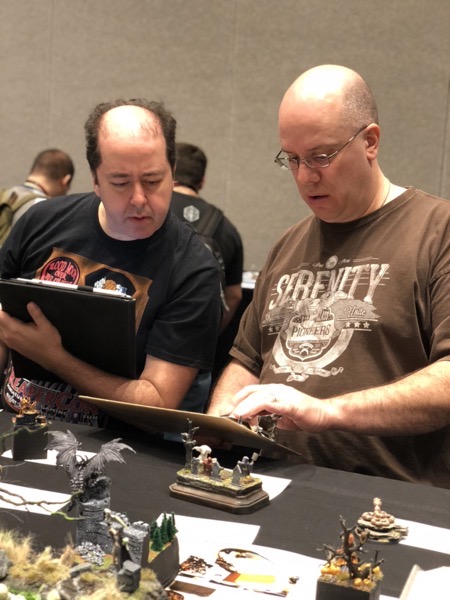 Dark Sword has generously supported convention contests for years. Here owner Jim Ludwig is assisted by painter Mengu Gregor in choosing the Dark Sword winners at the MSP Open in 2018.
Hybrid Contest
Hybrid contests often take inspiration from the open show model, but may organize their judging in whatever method they feel best suits their event and resources.
Who are the Judges?
Most often the judges of a competition are experienced miniature painters. The judges for manufacturer awards or other sponsored special awards are chosen by the sponsor, and can include a representative of the company, a miniature painter or sculptor, or other artist.
At a podium contest, the judges and even general contest volunteers may be prohibited from entering the contest themselves to forestall concerns about bias. When judges are permitted to enter, they do not assess their own work or make podium decisions in categories that include their own work.
Judges at an open show are given training to understand the judging criteria and process. They may undergo a sort of apprenticeship by ‘shadowing’ an established judge/team for one or more shows.
Judging a larger contest takes hours, and is often conducted late at night to minimize disruption to visitors eager to view the contest entries. Judges enjoy the privilege of being able to look all the entries up close and from different angles, but it is also a gruelling process filled with difficult decisions. Judges know how much work goes into an entry, and it is tough to know that your decisions will disappoint some of the entrants. Many judges also work as contest volunteers and/or hobby class instructors, which is a lot of additional work that limits their time to enjoy the event as a whole.
Contest Rules
Every contest has rules. While there are commonalities, the rules of each contest are unique, and often change slightly from year to year. The onus is on entrants to be aware of the rules for each competition they enter. Entries that don’t conform to the rules may be placed in a different category than the artist intended, or completely disqualified from consideration. If it is later discovered that someone did not follow the rules, they might be stripped of their award.
Contest rules include guidelines for each category, and maximum size of piece accepted. There may be rules related to the kinds of bases required or permitted. Most contests require entrants to attend the event in person. Many require that only the entrant have worked on the piece (apart from the use of commercially available figures and components). Others may not have rules forbidding multiple artists to work on an entry, but may only allow one entrant to be named as the creator.
Contests may limit the number of figures you can enter into a category and/or the overall contest. The contest might require anonymous entry, and forbid or limit the sharing of photos of your work prior to the event to support that. There may be very specific rules about the manufacturer, product line, size, basing style, or other elements allowed in each category. Many artists have had excellent pieces disqualified from consideration in a contest due to rules technicalities like these.
You will find a list of conventions and shows with miniature competitions at the bottom of this page. I have included links to any rules information I could find for each contest.
Submission and Pick Up
If you decide to enter a contest, be sure to familiarize yourself with the schedule for entering and retrieving entries. If it is possible, save yourself time and trouble by filling out entry forms in advance. A lot of people work on their piece until the last minute and crowd the entry area at the final deadline. Contest staff reserve the right to stop accepting entries after a certain time even if a line of people remains. Submitting your entries well before the deadline not only helps out the contest staff, it also gives you more time to enjoy other activities at the event.
You will not be able to pick up your entry prior to a certain time, and you must retrieve your entry by a certain time. Familiarize yourself with those times, and make your event and travel plans accordingly. Convention and show and show contracts include strict deadlines by which the event must pack up and vacate the venue. You may forfeit ownership of your entry if you do not pick it up by the deadline. Events are not under any obligation to ship unclaimed entries or prizes.
Usually you will be given a receipt during submission that you will need to present when you come to pick up your entries. This ensures that only the owner can claim miniatures. If you are unable to pick up your entries, you can give your receipt to a friend to retrieve them for you. If you earned an award or prize but did not attend the awards ceremony (or the contest doesn’t have an awards ceremony), you can usually pick it up at the same time as you reclaim your figures.
 Award ceremonies move fast and can be hard to photograph. It’s often easier to get good pictures of award winners with their trophies afterwards.
Left: David Diamondstone accepts a gold Sophie trophy from award presenter (and painter) Michelle Farnsworth.
Right: Michael Proctor poses with his Crystal Brush trophy following the awards ceremony.
Award Ceremonies
Many contests announce winners and award trophies and prizes at a scheduled awards ceremony. Since organizers know people may be involved in other events, it is generally not required to be present to accept your award. You will be able to pick it up later. (But of course check the rules, some contests may require you to be present to win!) If you have time in your schedule, try to attend the awards ceremony. It is a lot of fun to be presented your award and to see friends be recognized for their work!
First Cut
In podium style contests it’s common for judges to do what is often referred to as a first cut. The judges separate out the most competitive entries, and then rank these to select the final winners. Since it is an accomplishment to be up for consideration, some contests indicate which miniatures made first cut by placing them on a particular shelf in the display case, or adding a sticker or pin to their entry form.
Honourable Mention
Occasionally when there is a very tight race for placement, the piece that was not selected for the award will be designated as an Honourable Mention. The entrant does not receive a trophy or prize, but their work is acknowledged for its high quality.
 A judging team confers at Smoky Mountain Model Convention in 2019.
Judges’ Selection/Mention
Some contests award this regularly, some occasionally, some not at all. This honour is awarded to a piece that the judges loved, but which did not win another award. Often this is a piece that may not be the most superlative in terms of technical skills, but which is clever or thought-provoking in content and presentation.
Best in Show
Some contests award a Best in Show prize to a single piece or the top three pieces of the entire competition. The judges usually chose the Best in Show winner(s) from the pieces that were awarded first place in their category. In other contests, Best in Show might be awarded based on votes from viewers.
The Best in Show at the Reaper MSP Open is a modified popular vote contest. Everyone who has entered a piece in the MSP Open can vote for their favourite to win Best in Show. Three total prizes are awarded – overall Best in Show, runner up Reaper-made piece, and runner up non-Reaper manufactured piece.
Popular Vote
Some contests or some awards within a contest are awarded by popular vote. Popular vote via likes is common for online contests conducted on social media platforms like Facebook. In a popular vote contest, viewers or a subset of viewers chose their favourite piece, and the one with the most votes wins. Viewers tend to be drawn to the same kinds of quality as judges, but they are also influenced by other factors. Viewers are more likely than judges to factor in their personal feelings about the sculpt rather than considering only the merits of the workmanship and presentation. Viewers are as strongly drawn to story and character as they are to technical prowess. When considering technique, viewers tend to put a lot of value on techniques that are considered challenging, like freehand or source lighting, but they may not assess these with as critical an eye as many judges would. Viewer votes may not recognize the challenge level of more subtle techniques like smooth blending or complex colour use.
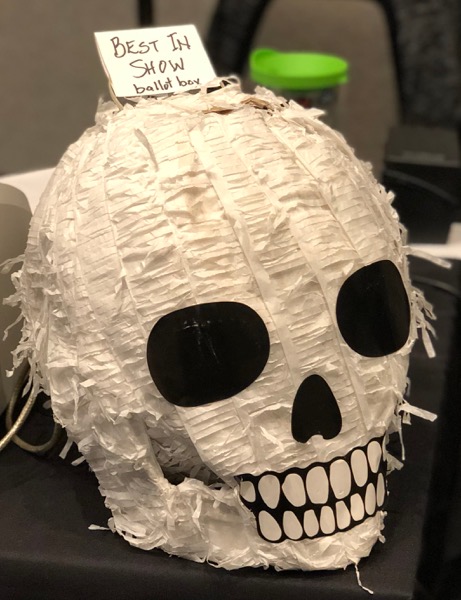 Voting can be serious and thematic!
Category Divisions
Many contests divide entries into different categories. These may be based on subject, size, number of figures, or other criteria. Make sure you understand the guidelines for every category you plan to enter.
Podium contests often divide categories by size and broad type. Examples might include gaming scale Sci-Fi/Modern Single, Monster, Bust, Large, Unit.
Open shows group figures regardless of size into Painter (the focus is primarily on painting), Open (the focus includes both sculpting and painting), and Ordinance (vehicles). Some shows have two categories for both Painter and Open – Fantasy (which includes science fiction and horror), and Historical (which includes any period of real history, including modern day.) Some open shows may have additional categories, such as diorama/vignette.
Skill Level Divisions
Many contests have a Youth or Junior division or award system to encourage younger people to try out the hobby and participate in contests.
Some open shows have a grand master or similar group, to which one or two new members are added each year. The criteria for being voted into grand master generally includes not only having entered consistently high level work over several years, but also having made contributions to the club or hobby as a whole. The MSP Open has the MSP Medallist group. The existing members vote in one new member per year. While this is a great honour, it comes with a penalty. If the work they enter into the MSP Open does not merit a gold medal, they will not receive any award.
People often express the desire for competitions to create separate categories for ‘regular’ painters and ‘expert/pro’ painters. While in theory that seems like a way to spread awards out amongst more people, in practice no one has yet come up with a feasible way to determine which entrant falls into which category. There are people who paint at a tabletop standard and make their living selling miniatures, and there are people who paint only as a hobby that might spend hundreds of hours painting one entry to a very high standard. Most contests have decided that the way to approach the issue is to judge the quality of the entries, rather than trying to determine the skill category most appropriate for each entrant. I have occasionally encountered a competition that removes previous winners of any regular award from the general categories. These instead compete against each other in a sort of masters category. The Capital Palette is an open format contest at the NOVA Open convention that accepts entries into three divisions – Apprentice, Journeyman, and Masterclass.
Entrance Fees
The cost to enter a contest or show varies considerably. Remember that there are expenses for running a competition. Events have to rent space from the venue and equipment like display cases or tables, and the cost of these can be considerable. Purchasing awards like trophies, ribbons, and medals is another additional cost. Fee options include:
* There is no fee or the fee is included with your event pass.
* There is a separate fee for exhibitors (entrants), but it covers as many entries as you are permitted under the contest rules.
* There is a fee to enter the contest, or a fee for each piece entered into the contest.
 Awards and winners in the junior division at Gen Con 2011.
Viewing Entries
Contests that are held as part of a gaming convention are usually located in a high traffic area. Entries are placed on shelves in tall glass-fronted display cases. Viewing the entries can be a crowd jostling experience at busy conventions, and you may have to bend down or stand on tiptoe to see all the pieces. It is common for the largest pieces to be placed on the bottom shelves. Others are usually grouped by category. The display cases are locked when the contest staff is not available, and if they are located in a room like a dealer hall, the room is locked during off-hours, as well. At Gen Con the display cases of the main contest are in a busy hall, so they’re still accessible for viewing at odd hours. Even late at night there is enough traffic in the halls to deter thoughts of funny business.
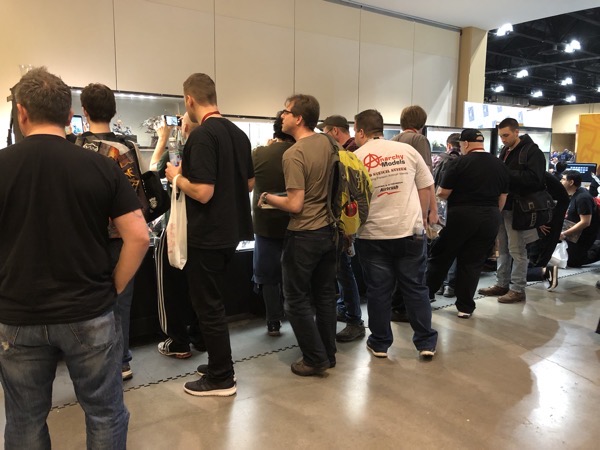 The display cases at Crystal Brush 2018 at Adepticon. Display case viewing isn’t always this busy, but it’s not uncommon.
One of the fun features of open format shows is that entries are displayed on tables. Entrants arrange their displays as they wish, which may include risers, backdrops, or other elements. They must do this within the constraints of the available display space and the needs of other entrants, however. The display tables are usually raised to approximately chest height. This is convenient for viewing by average height viewers, but may present difficulties to those in wheelchairs or of smaller stature. The tables are typically spread out around an entire room, so viewing tends to be less crowded than around display cases. There is no separation between viewer and entries, which allows you to examine the entries from different angles and without light glare, etc. Volunteer staff are usually on hand to remind viewers not to touch the figures or to ask parents to remove rowdy children who might jostle the tables. Display rooms are open for set hours and are locked when closed.
 All of those tables are filled with fantastic entries. And that wasn’t even the whole room! World Expo 2017 in Chicago.
The Safety of Your Miniatures
Entrants assume all risk when they enter pieces into a contest. Contest staff make every effort to treat figures with great care, but accidents do happen. Even at a show where you yourself set up the display of your figure(s), you should assume that your piece may be handled by the contest staff. Judges often pick pieces up to look at them from different angles. Figures may be transferred to a side table to be photographed, or gathered together to be judged for a special category or manufacturer award. If more figures are entered than expected, contest volunteers may need to rearrange the tables to try to make room for other entrants.
I advise you to assemble your figures sturdily and completely. If you include a base or plinth, attach the figure(s) to it securely. Judges are trained to pick pieces up by the base or plinth to minimize touching the paint job on the figure itself. In an open show, you can include a sign with your display that a particular piece is fragile or not well attached and that will generally be respected, but bear in mind that you are still taking a bit of a risk. Partially assembled figures are not feasible to enter into a traditional display case contest.
 Many contests use padded trays to transport miniatures to the contest case or photograph booth. These were entries at Gen Con 2013.
All of that said, it is rare for a figure to be damaged in a contest in my experience. It happens, but it’s rare. Transporting your figures to and from the event presents more dangers. You need to secure them against the rigours of travel, and also bear in mind dangers like a suitcase falling on your figure case or airport security opening your case without warning. Secure figures in position with bubblewrap, poster tack, double-sided tape or other means. Try to stay close to your case as it is examined at the airport so you can offer advice about the best way to open it if they want to test the interior. Be leery of packing fragile pieces that need careful wrapping in your checked luggage, as security staff may open your suitcase and any container within it during the screening process.
The list of conventions and shows with miniature contests that was previously located on this page has been split off to its own page: Contest and Show Calendar for Miniature Painting and Sculpting
Many thanks to Jen Greenwald and Michael Proctor for fact checking and suggestions for additions.

 Bird with a Brush
A few more competitions to add to your list:
Wargames Illustrated Hammerhead Painting Competition; Newark, UK
https://www.wargamesillustrated.net/the-hammerhead-2022-painting-competition/
Euroma
https://www.facebook.com/groups/368061026691855/
Rome, Italy
Moson Show
http://www.mosonshow.hu/?page_id=1506
UFM Aréna, Mosonmagyaróvár, Hungary
23 – 24 Apr 2022
LikeLike
Thank you so much for the information on some more shows and contests! I’ve added those to the lists.
LikeLike
TantrumCon in Charlotte, NC (www.tantrumcon.com) will have a “local” competition. Pick up a mini and paint it at the Paint & Take booth over the weekend. This competition mostly for beginners, so the “2 day paint” is one of the requirements.
LikeLike
Sounds great, thank you for letting us know about it!
LikeLike